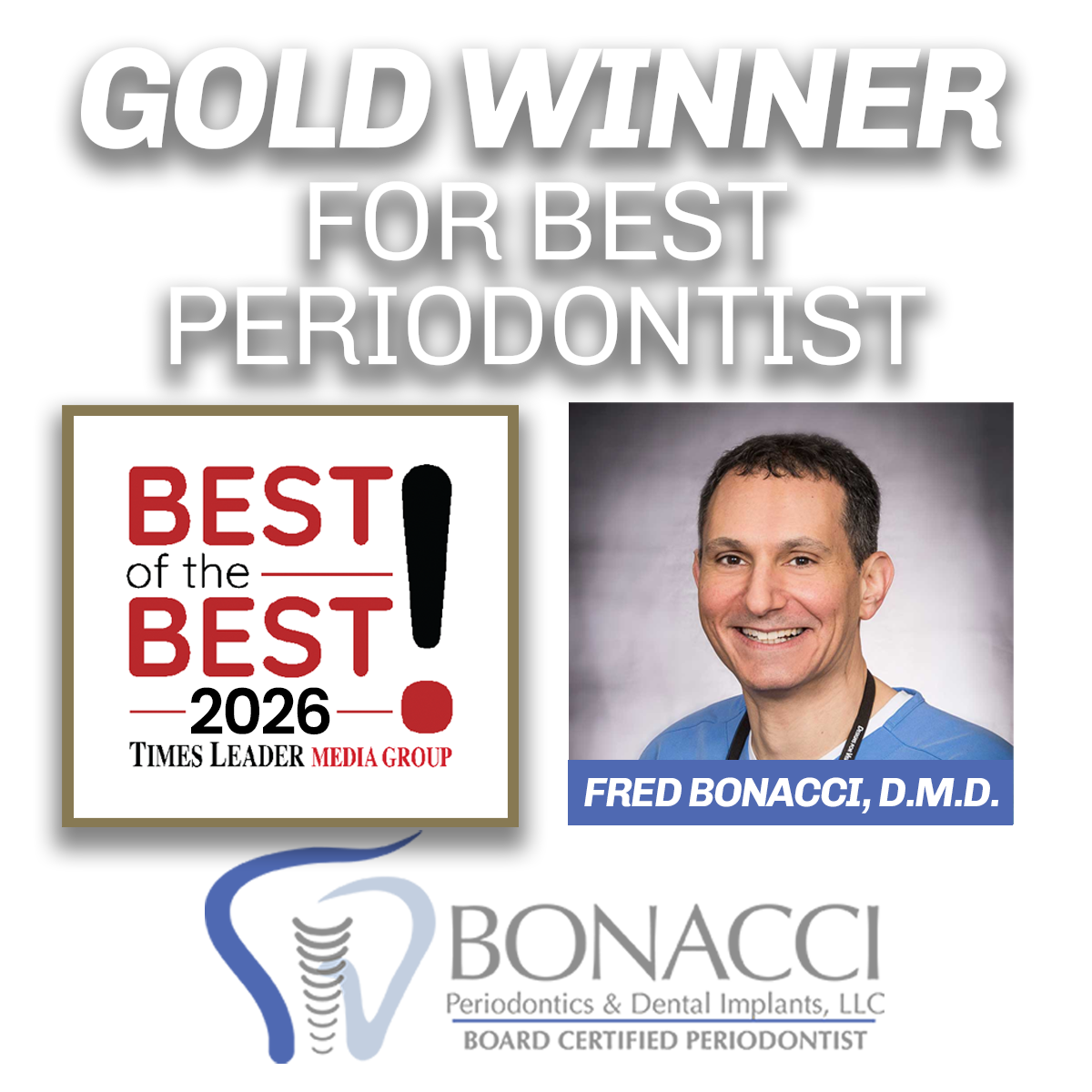

Vote For Us!
What is a Periodontist Specialist?
Periodontists are general dentists who have completed an additional 3 years of formal school based residency training beyond dental school. Periodontics is one of several accredited specialties recognized by the American Dental Association. The culmination of this training for many but not all periodontists is certification by the American Board of Periodontology in the disciplines of Periodontics and Dental Implants.
Periodontal & Dental Implant Specialist
All dentists complete a formal 4 year dental school education where they are taught the basics about the health and care of teeth, gums, supporting bone structures, and the jaw. Although requirements vary for each dental school, most require a bachelor’s degree. Typical basic coursework includes anatomy, the study of oral health and disease, radiology, local anesthesia, and tooth related restoration procedures.
Welcome to BONACCI Periodontics & Dental Implants
Dr. Fred Bonacci, D.M.D. is a true Periodontal & Dental Implant Specialist located in Northeastern Pennsylvania.
Here are just a few benefits of our Dental Implant procedure:
- Science based “longterm” therapy options
- Conservative surgical approaches
- Quality research supported Dental Implants and Dental Materials
- Reduced healing times and number of office visits
- Immediate temporary tooth/teeth solutions available to avoid “removable flipper
- denture style”
- Dental Implants maintain jawbone and help prevent jawbone loss
The Team at Bonacci Periodontics and Dental Implants
Throughout his career, Dr. Bonacci has worked on thousands of complex cases that provide him a great advantage as he treats his patients today. He is committed to continual education, as he expresses the value of possessing as much knowledge as possible in order to provide patients the care they deserve and need. In support of his efforts towards continual learning, Dr. Bonacci works closely with other local and international dental practitioners to ensure he is always equipped with the latest information regarding procedures, technology, medicine, etc..

Traditional flap-based approaches all too often result in membrane exposure, infection and soft tissue dehiscences. These complications lead to loss of papillae, recession, and gingival defects; with catastrophic consequences in the esthetic zone. After achieving successful early results, the S.M.A.R.T. method was applied in an expanding range of applications including horizontal augmentation, buccal plate regeneration on natural teeth and implants, and vertical augmentation.